


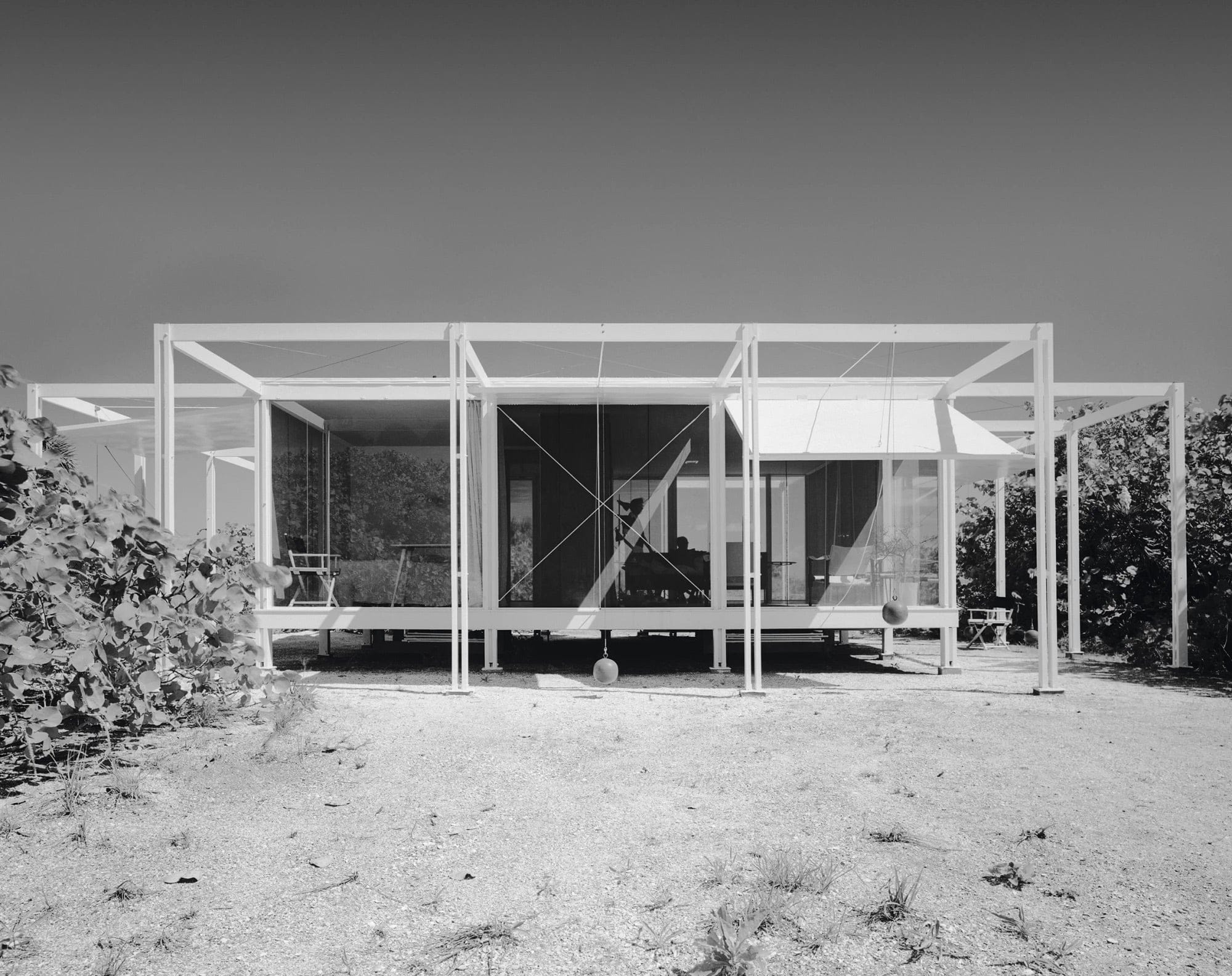
THE WALKER GUEST HOUSE
THE WALKER
GUEST HOUSE
BY PAUL RUDOLPH
AVAILABLE OFF-MARKET | $2,000,000
In collaboration with Basic.Space, the Walker Guest House will be exhibited at the Pacific Design Center from Friday, March 27 to Sunday, March 29, 2026. It is offered for sale with its original interior furnishings and architectural plans — an exceptionally rare distinction for a structure of this period, and a testament to the care with which it has been preserved across more than seven decades.
Designed by Paul Rudolph at the age of thirty-three, the Walker Guest House was his first independent commission following his split from architect Ralph Twitchell, and the project that launched his ascent as one of the most influential architects of the twentieth century. In 1957, Architecture Record readers voted it one of the most important houses of the century — alongside Mies van der Rohe's Farnsworth House and Philip Johnson's Glass House — a distinction it retains to this day. The house's most distinctive feature is its system of adjustable exterior wooden panels, raised and lowered by 77-pound, red-painted cannonball counterweights sourced from its original site on Sanibel Island, Florida. When closed, they function as shutters; when opened, they form shaded canopies — allowing the structure to continuously transform in response to light, climate, and use. The Walker family and Sanibel residents nicknamed it "The Cannonball." Rudolph believed people need both "caves" and "goldfish bowls" to live in; this house delivers both within a single architectural form. He described his earliest designs as "sketches in the sand" and the finished structure as something that "crouches like a spider in the sand" — alive to its environment in a way few buildings ever achieve. Commissioned by Walter Walker — Harvard-trained physician, investment manager, and grandson of T.B. Walker, the Minnesota lumber baron who founded the Walker Art Center in Minneapolis — the Guest House reflects a lineage of American patronage rooted in art, architecture, and civic engagement. This is a singular opportunity to acquire one of the defining works of American modernism, intact and in private hands for the first time in a generation.
This is a singular opportunity to acquire one of the defining works of American modernism, intact and in private hands for the first time in a generation.
Represented by Jenna Cooper in collaboration with Basic.Space.
In collaboration with Basic.Space, the Walker Guest House will be exhibited at the Pacific Design Center from Friday, March 27 to Sunday, March 29, 2026. It is offered for sale with its original interior furnishings and architectural plans — an exceptionally rare distinction for a structure of this period, and a testament to the care with which it has been preserved across more than seven decades.
Designed by Paul Rudolph at the age of thirty-three, the Walker Guest House was his first independent commission following his split from architect Ralph Twitchell, and the project that launched his ascent as one of the most influential architects of the twentieth century. In 1957, Architecture Record readers voted it one of the most important houses of the century — alongside Mies van der Rohe's Farnsworth House and Philip Johnson's Glass House — a distinction it retains to this day. The house's most distinctive feature is its system of adjustable exterior wooden panels, raised and lowered by 77-pound, red-painted cannonball counterweights sourced from its original site on Sanibel Island, Florida. When closed, they function as shutters; when opened, they form shaded canopies — allowing the structure to continuously transform in response to light, climate, and use. The Walker family and Sanibel residents nicknamed it "The Cannonball." Rudolph believed people need both "caves" and "goldfish bowls" to live in; this house delivers both within a single architectural form. He described his earliest designs as "sketches in the sand" and the finished structure as something that "crouches like a spider in the sand" — alive to its environment in a way few buildings ever achieve. Commissioned by Walter Walker — Harvard-trained physician, investment manager, and grandson of T.B. Walker, the Minnesota lumber baron who founded the Walker Art Center in Minneapolis — the Guest House reflects a lineage of American patronage rooted in art, architecture, and civic engagement. This is a singular opportunity to acquire one of the defining works of American modernism, intact and in private hands for the first time in a generation.
This is a singular opportunity to acquire one of the defining works of American modernism, intact and in private hands for the first time in a generation.
Represented by Jenna Cooper in collaboration with Basic.Space.

Use this text to share information about your brand with your customers. Describe a product, share announcements, or welcome customers to your store.
PHOTO GALLERY
REQUEST A SHOWING

